
/المدونة
نشارككم أحدث ابتكارات التقنية، أسرار تجربة المستخدم، وأدوات الميديا الرقمية.
اكتشف عالم التقنية والابتكار مع مقالاتنا المتجددة.


2026-08-20
Web Development

Eng. Mohamed RedaFront-End Developer
Front End: How the Browser Works Behind the Scenes
Discover the magic of front end web development by understanding how the browser works. Learn about parsing, rendering, and painting web pages efficiently.
The Initial Request and Response Process
- When you type a web URL into your address bar, the browser immediately relies on the Domain Name System to resolve the human-readable domain name into an exact IP address required to locate the target server on the internet.
- After resolving the address, the browser actively establishes a highly secure connection using standard TCP and TLS handshakes, guaranteeing that all sensitive data transmitted between the client device and the web server remains completely private and untampered.
- Once the secure connection is successfully established, the browser dispatches an HTTP GET request to the hosting server, explicitly asking for the main HTML document of the web page to initiate the complex content loading sequence.
- Finally, the web server thoroughly processes this incoming request and sends back a comprehensive HTTP response containing the requested HTML payload, effectively marking the exciting beginning of the browser's multifaceted and intricate page rendering phase.
Parsing HTML and Building the DOM Tree
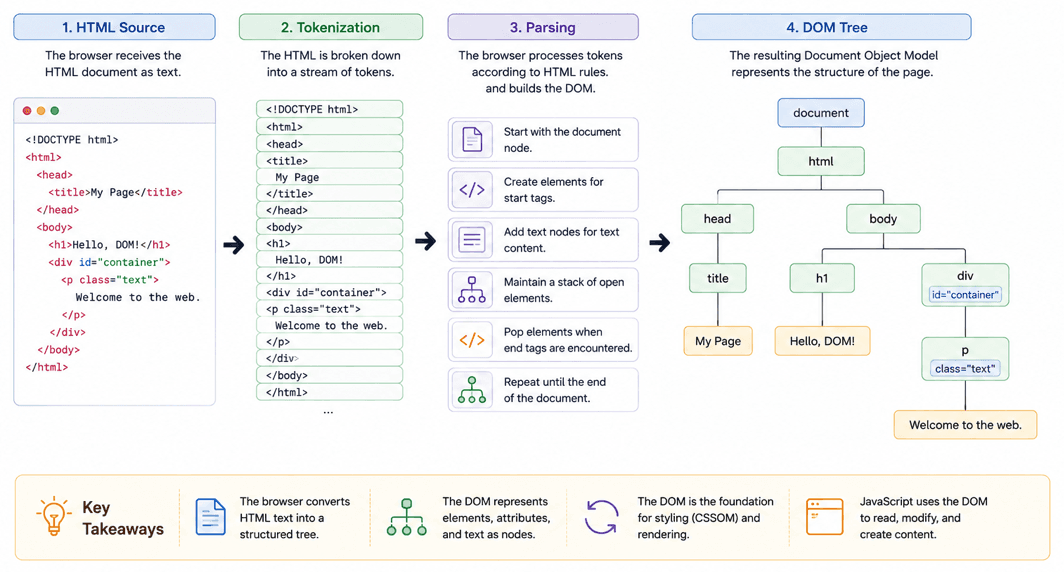
- Upon receiving the payload, the browser diligently begins parsing the HTML document line by line, intelligently converting the stream of raw bytes into identifiable characters, standard tokens, and eventually structured nodes representing the underlying page layout.
- These individually created nodes are then meticulously linked together in a hierarchical tree to formally construct the Document Object Model, universally known as the DOM tree, which serves as the ultimate living representation of the entire web document.
- Whenever the busy parser unexpectedly encounters synchronous JavaScript tags or external stylesheet links, it must immediately pause all ongoing HTML parsing to aggressively fetch and execute those absolutely critical blocking resources before safely continuing down the page.
- Once fully constructed, this dynamic DOM tree acts as the fundamental architectural blueprint for the web page, actively empowering JavaScript code to seamlessly interact with, eagerly query, and dynamically manipulate the existing content structure later.
Processing CSS and Constructing the CSSOM
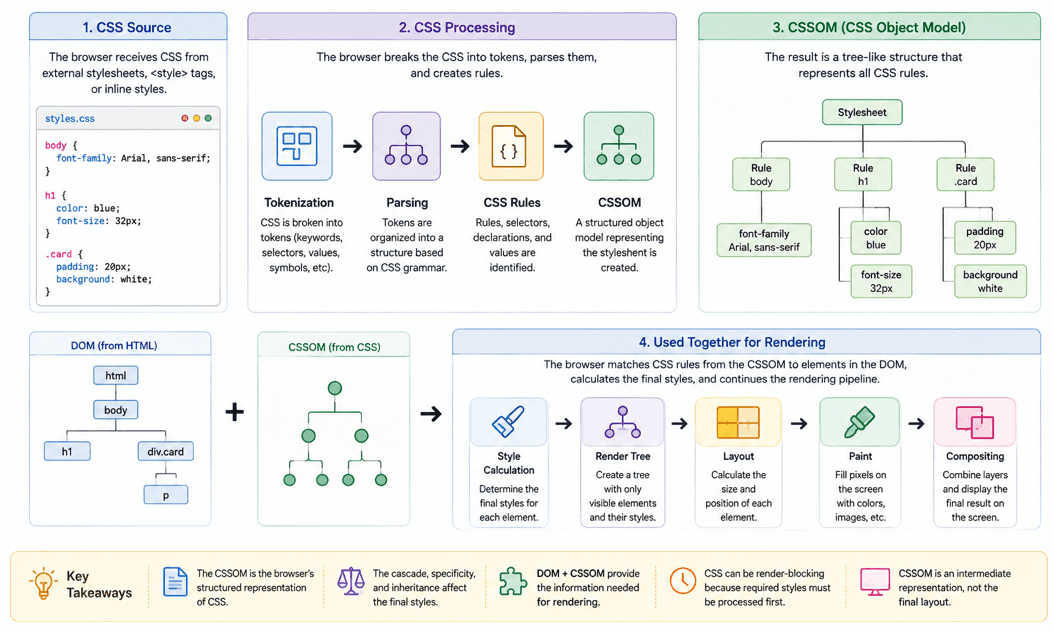
- Operating in a highly similar fashion to how HTML is parsed, the modern browser systematically processes CSS styles from both external stylesheets and inline style tags to carefully construct the comprehensive CSS Object Model, or CSSOM.
- The resulting CSSOM works in perfect harmony with the DOM tree, explicitly defining the specific visual properties, such as precise colors, exact sizing, and complex positioning rules, for every single corresponding node present within the parsed document.
- Processing cascading stylesheets is considered an inherently render-blocking operation by design, heavily meaning the browser absolutely will not paint any visual pixels on the user's screen until the entire CSSOM tree is completely built and fully verified.
- Delivering optimized CSS is absolutely crucial for modern front end performance, primarily because significantly reducing the file size and architectural complexity of stylesheets directly accelerates the critical initial rendering timeline of any given web page experience.
Generating the Render Tree for Layout
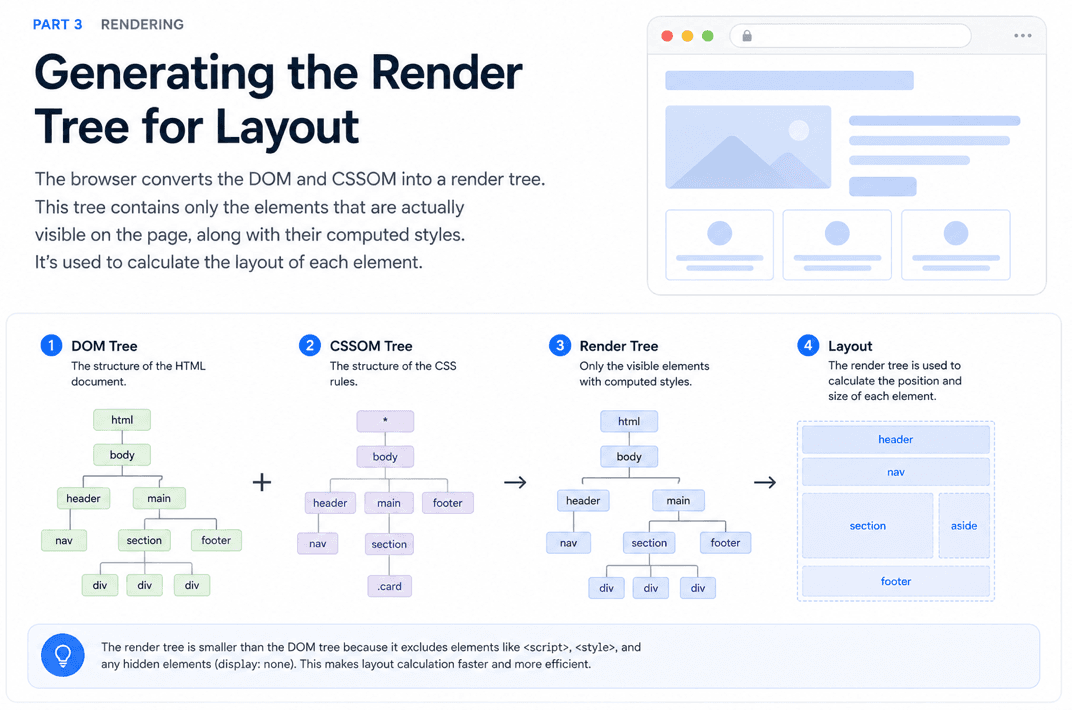
- Moving forward in the pipeline, the browser smoothly combines both the completed DOM and CSSOM trees into a single unified structural entity known as the Render Tree, containing strictly the specific nodes required to visually display the page.
- Specific DOM elements dynamically hidden using cascading style properties like display none are intentionally completely excluded from this finalized Render Tree, smartly ensuring the busy browser does not carelessly waste valuable computing resources actively calculating their invisible layout.
- Armed with the freshly built Render Tree, the browser confidently proceeds directly to the layout phase, systematically computing the exact geometric size and precise physical coordinate position of every single visibly rendered element across the device's screen.
- This intensive layout process, frequently referred to in the industry as reflow, is computationally highly expensive, practically demanding that front end developers rigorously minimize structural layout changes to guarantee buttery smooth scrolling and optimal continuous performance metrics.
Painting Pixels and Compositing the Layers
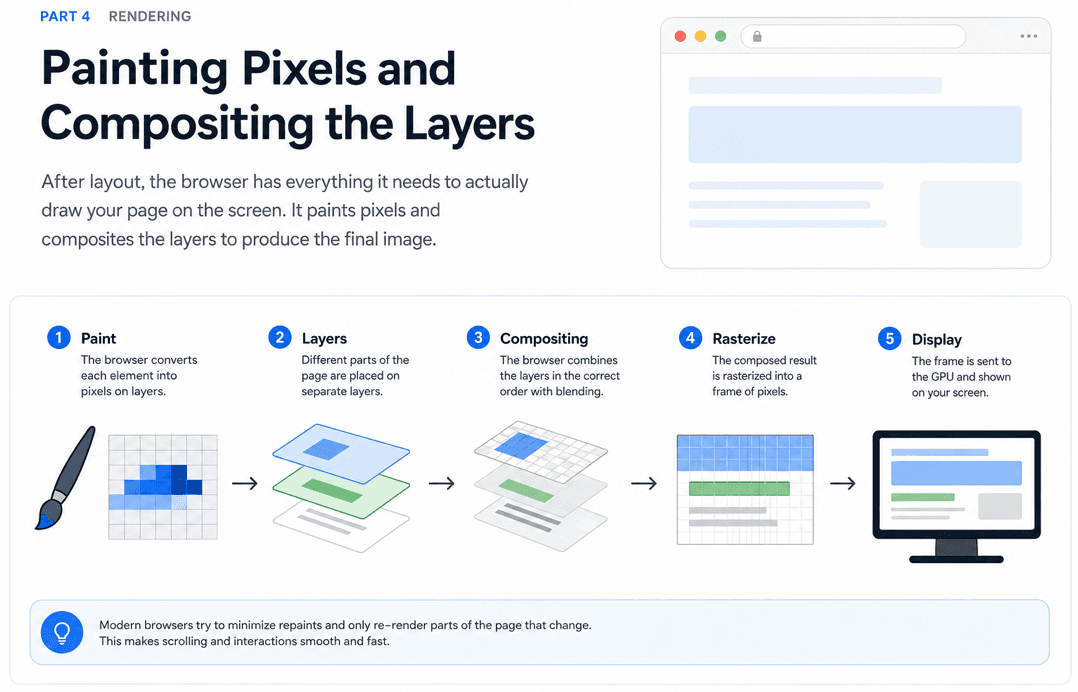
- Directly after rigorously calculating the precise mathematical layout, the browser gracefully enters the crucial paint phase, where it visually draws every pixel of text, vibrant colors, embedded images, and structural borders for every specific node directly onto the screen.
- To significantly optimize the overall rendering performance, the sophisticated browser frequently divides the various visual elements into multiple separate composite layers, strategically painting them entirely independently to easily prevent highly unnecessary visual repaints of the entire web page.
- During the extremely final compositing step of the pipeline, the browser's dedicated graphics processing unit seamlessly and rapidly merges all these individual painted visual layers together in the absolutely correct physical order to correctly display the beautiful final image.
- Deeply understanding this highly complex and fascinating rendering pipeline actively empowers dedicated front-end developers to skillfully craft heavily optimized, exceptionally responsive web applications that consistently deliver truly exceptional and memorable user experiences across all modern web browsers.